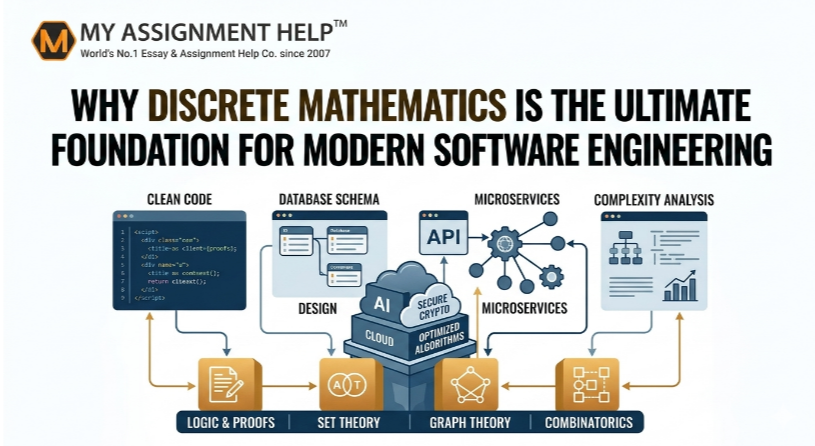
The contemporary landscape of software engineering across Australian tech hubs—from Silicon Beach in Sydney to Richmond’s booming startup precinct in Melbourne—is undergoing a structural shift. For over a decade, the narrative surrounding software development was heavily centered on learning practical syntax, mastering framework lifecycles, and deploying rapid Minimum Viable Products (MVPs). However, as engineering teams increasingly encounter complex infrastructural barriers, distributed system bottlenecks, and the compute demands of large language models, syntax proficiency has lost its competitive edge. Industry leaders now recognize that the differentiator between an ordinary code architect and a world-class systems engineer lies in a deep proficiency in discrete mathematics.
Unlike continuous mathematics—such as calculus or fluid dynamics, which deal with smooth, unbroken variables—discrete mathematics isolates distinct, separated values. It is the literal formalised grammar of digital computation. Because binary transistors operate strictly within the discrete states of $0$ and $1$, every high-level software abstraction, algorithmic loop, database index, and cryptographic handshake ultimately distils down to discrete mathematical foundations. Australian universities, including the Group of Eight (Go8) institutions, heavily weight discrete units within their computer science curricula because it trains the mind in rigorous, deterministic structural logic.
For many undergraduate scholars navigating these intense theoretical modules at institutions like the University of Melbourne, the University of Sydney, or UNSW, the transition from high school algebra to abstract proofs can be exceptionally punishing. When multi-variable constraint problems, predicate calculus proofs, and recursive set structures converge during high-stakes mid-semester assessment windows, maintaining academic momentum becomes difficult. Under these stressful conditions, accessing targeted guidance from an established academic platform like myassignmenthelp can offer crucial structural support. Getting comprehensive Mathematics assignment help ensures that students can map abstract proofs back to real-world software paradigms, mastering their university coursework while preserving the mental bandwidth required to build out their technical portfolios.
1. Formal Logic: The Blueprint of Bug-Free Code Execution
At the absolute core of every conditional branch, automated test suite, and compilation sequence sits formal propositional and predicate logic. Software engineers spend a significant portion of their professional lives evaluating conditions: determining exactly when an execution thread should branch, when a loop should terminate, or how system states change across distributed microservices. Without an explicit understanding of formal logic laws—such as De Morgan’s Laws, existential quantifications ($\exists$), and universal quantifications ($\forall$)—complex nested conditions rapidly degrade into unmaintainable, bug-prone software architecture.
Consider De Morgan’s Laws in Boolean algebra, which are mathematically expressed as:
$$\neg(P \wedge Q) \leftrightarrow (\neg P \vee \neg Q)$$
And conversely:
$$\neg(P \vee Q) \leftrightarrow (\neg P \wedge \neg Q)$$
In industrial software applications, refactoring complex conditional loops using these structural identities is the direct key to minimizing cognitive load and preventing silent runtime errors. When engineers write comprehensive integration tests, they are fundamentally validating logical assertions. If a software engineer cannot formally model the state space of a system, they cannot confidently write tests to cover its edges. In high-stakes fields such as automated fintech trading platforms in Sydney or autonomous medical software developed in Adelaide, unproven conditional assumptions lead to catastrophic, multi-million-dollar system crashes.
2. Set Theory and Relational Algebra: The Engines of Modern Databases
Every time a backend engineer writes an optimized SQL query, executes a complex database migration, or establishes data models within a distributed cache, they are not merely interfacing with a software wrapper—they are executing relational algebra. Developed by Edgar F. Codd in 1970, the relational database model is built entirely on mathematical set theory. Data tables are formal sets of tuples, and operations like SELECT, PROJECT, and JOIN map directly to mathematical selections, projections, and Cartesian products ($A \times B$).
When query planners within enterprise databases like PostgreSQL or MySQL calculate the most efficient index path, they rely on relational algebraic optimizations. An engineer who lacks an understanding of set intersections, unions, and subsets will invariably write highly inefficient, unindexed queries that choke under production scale. For example, failing to grasp the computational complexity of a Cartesian product causes naive loops that scale exponentially, turning an innocent query into a system-wide database lockup during peak Australian traffic hours.
3. Graph Theory: Navigating Networks, Git, and Social Fabrics
Perhaps the most visually intuitive and widely deployed branch of discrete mathematics in software engineering is graph theory. A graph, defined formally as a set of vertices $V$ and edges $E$, represented as $G = (V, E)$, serves as the fundamental abstraction for modeling interconnected structures. If you have ever committed code via Git, tracked a packet across an AWS Virtual Private Cloud, or looked at a recommendations engine, you have interacted directly with graph theory.
Consider how modern version control systems operate. Git does not store simple linear file snapshots; it manages a Directed Acyclic Graph (DAG) of commit objects. Merging branches, resolving conflicts, and performing rebases are purely graph operations designed to traverse and manipulate this DAG without introducing cycles. Similarly, network routing algorithms like Dijkstra’s algorithm or the Bellman-Ford algorithm constantly calculate the shortest, most cost-effective path for data packets across the internet. When Australian logistics platforms like Australia Post optimize delivery routes, or financial networks map out transaction dependencies to detect fraudulent loops, they rely entirely on graph traversal algorithms.
“Software engineering without graph theory is like structural engineering without calculus. You can piece elements together through intuition, but you can never mathematically prove the resilience, efficiency, or scalability of your structure under load.”
4. Combinatorics and Big O Notation: Predictive Performance Scales
In an era where software must routinely scale to serve millions of concurrent API calls, understanding system limits before writing code is non-negotiable. This is where combinatorics—the mathematics of counting, arrangement, and permutation—intersects with algorithmic complexity analysis, universally known as Big O notation. When building backend routing, caching systems, or search engines, engineers must know how resource consumption scales relative to the input size $n$.
Through combinatorics, an engineer can calculate the exact size of a system’s state space or the total possible outcomes of a specific cryptographic combination. This directly informs the algorithm’s runtime bound. For instance, an algorithm with a combinatorial complexity of $O(n!)$ or $O(2^n)$ will completely freeze a system even with a modest input size of $n = 50$. By understanding the Pigeonhole Principle—which states that if $n$ items are put into $m$ containers where $n > m$, at least one container must hold more than one item—engineers can mathematically guarantee hash collisions in data structures, allowing them to proactively write collision resolution strategies like open addressing or chaining.
When academic requirements demand that you implement these abstract concepts from scratch in raw code under strict timelines, it can be deeply overwhelming. If you feel stuck trying to balance complex algorithmic proofs with operational deadlines, simply asking an expert to help me with my assignment can drastically flatten the learning curve. Professional interventions provide highly contextualised, step-by-step code implementations of mathematical models, giving you a crystal-clear template to understand how theory transforms into production-ready software systems.
Key Takeaways for Aspiring Engineers
- Discrete is Digital: Modern computers operate in discrete binary states; discrete mathematics provides the direct native language for this computational environment.
- Optimized Databases: True mastery of SQL query engineering and indexing is impossible without an understanding of relational algebra and set theory operations.
- Architectural Mastery: Complex modern tools like Git, cloud network routing, and distributed microservice dependency trees are built directly upon Directed Acyclic Graphs (DAGs).
- Scalability Protection: Combinatorics and Big O notation allow engineers to predictively calculate performance ceilings, preventing massive, expensive system failures in production.
Frequently Asked Questions (FAQs)
1. Can I become a competent software engineer without learning discrete mathematics?
While you can certainly learn basic syntax, build standard websites, and operate as a junior developer without discrete math, your career trajectory will eventually hit a structural ceiling. Advanced engineering specialisations—such as cloud architecture, compiler engineering, cryptographic systems, game engine development, and machine learning—require a mastery of discrete structures to manage complexity and prove algorithmic efficiency.
2. How do Australian tech companies evaluate discrete math skills during interviews?
Top-tier tech firms across Sydney, Melbourne, and Brisbane rarely test you on raw mathematical syntax; instead, they embed discrete math principles into their technical whiteboard rounds. When an interviewer asks you to traverse a tree, detect a cycle in a network graph, or analyze the time complexity of a recursive algorithm, they are assessing your functional mastery of discrete graph theory and combinatorics.
3. Why is discrete math considered harder than standard university calculus?
Calculus relies heavily on continuous variables, graphical intuition, and memorable formulaic steps (like differentiation and integration). Discrete math, however, forces you into a highly abstract world of absolute logic, set relations, and rigorous formal proofs where answers cannot simply be guessed or approximated. It requires an entirely different style of logical reasoning, which is why many computer science students find it challenging initially.
4. Where can I find professional academic support if I am failing my university discrete math unit?
If you are struggling with complex truth tables, graph traversals, or relational calculus proofs, seeking external academic guidance is highly recommended. Utilizing targeted professional tutoring or specialized assignment frameworks from platforms like myassignmenthelp ensures you receive broken-down, readable explanations of complex proofs, keeping your academic transcripts in excellent shape.
About The Author
Senior Content Strategist & Academic Consultant | myassignmenthelp
The author is a seasoned computer science educator and senior research lead specializing in algorithmic engineering and discrete structural models. With over a decade of experience guiding higher-education scholars across elite Australian universities, they specialize in breaking down complex mathematical proofs into actionable software development workflows. Through their academic insights at myassignmenthelp, they continue to empower the next generation of software engineers to look past simple code syntax and embrace the mathematical logic that drives modern digital innovation.
References & Academic Sources
- Codd, E. F. (1970). A Relational Model of Data for Large Shared Data Banks. Communications of the ACM, 13(6), 377–387.
- Rosen, K. H. (2019). Discrete Mathematics and Its Applications (8th ed.). McGraw-Hill Education.
- Australian Computer Society (ACS). (2025). Core Body of Knowledge for ICT Professionals. Professional Standards Framework.
- Group of Eight (Go8) Australia. (2026). Trends in STEM Enrollment and Algorithmic Prerequisites in Australian Higher Education. Academic Insights Report.